
The Watchers: What the Bible Leaves Unsaid About Noah and the Giants
Introduction to the Reader
The account you are about to read does not belong to the biblical canon, yet it illuminates one of its most unsettling silences.
In Genesis, only a few verses allude to mysterious events: the “sons of God” who unite with the daughters of men, the birth of giants, and a corruption of the world so profound that it leads to the Flood. The biblical text names these things—and then moves on.
The Book of Enoch, by contrast, lingers precisely where the Bible falls silent.
It unfolds what is missing: the identity of these heavenly beings known as the Watchers, their fall, the transmission of forbidden knowledge, the origin of the giants, and the direct link between this cosmic transgression and the coming of the Flood. It also tells of a singular birth—that of Noah, a child of light, announced as the survivor of a condemned world.
This text is neither a late invention nor a mythological fantasy. It deeply shaped ancient Jewish imagination, nourished apocalyptic thought, and left visible traces in the New Testament. It proposes a vertiginous reading of evil: not only human in origin, but born of a rupture between heaven and earth.
What follows is a narrative retelling of this ancient account—faithful to its spirit, yet rendered more vivid and accessible, so that the modern reader may grasp its power, its gravity, and its final horizon of hope.
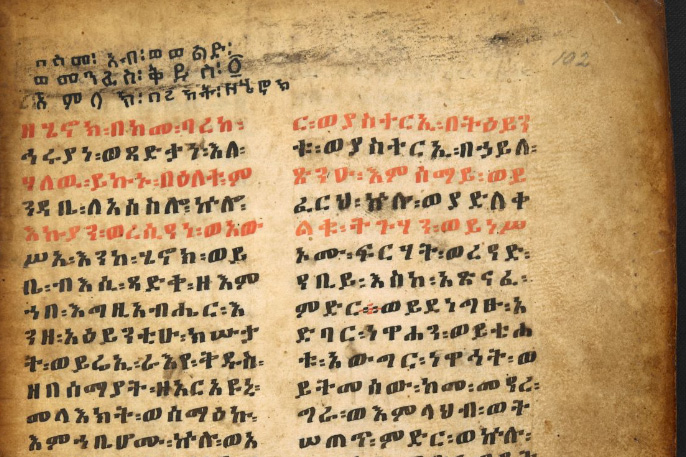
The opening of the Book of Enoch, preserved in an Ethiopian Geʽez manuscript (16th century).
The Watchers
When humankind began to multiply upon the earth, heaven was still watching.
They were called the Watchers. Beings of light, appointed to observe humanity, to guard its fragile order, and never to cross the boundary separating the eternal from the perishable. Yet as they gazed upon the earth, their vision grew clouded.
They saw the daughters of men. They saw their beauty. And desire entered where vigilance alone was meant to dwell.
Then twenty leaders rose up, led by Shemêhaza, Azaël, and Kokabiel. Two hundred angels followed them. Upon Mount Hermon they swore an oath together—not as isolated transgressors, but as a pact. If they were to fall, they would fall as one.
That night, heaven opened in a guilty silence.
The Watchers took human wives. They begot children—vast, insatiable, violent. The giants were born, and the earth groaned beneath their weight. They consumed the harvests, then the livestock, and finally mankind itself. Blood covered the ground, and the cries rose to the clouds.
Yet corruption did not come from strength alone.
The angels taught humanity what was never meant for it: metalworking, weapons, enchantments, the signs of the stars, secrets that deform the soul before they shatter the body.
The earth was filled with violence. And heaven could no longer turn away.
The Cry of the Archangels
Then Michael, Gabriel, Raphael, and Uriel stood before the Most High. They saw the earth laid waste, order undone, the first creation disfigured. And they spoke.
The answer was without appeal.
Azaël was bound and cast into the deep darkness. The giants were given over to mutual destruction. The Watchers were condemned to be chained for seventy generations, powerless witnesses to the ruin they had unleashed.
The earth would be cleansed. Justice would return. But the cost would be immense.
The Rejected Plea
Then the Watchers turned to Enoch.
They no longer dared lift their eyes. They no longer dared pray. They asked the righteous man to write for them, to speak in their place, to plead where they themselves had lost all voice.
Enoch wrote. He read their petition near the mountain where everything had begun. Then sleep overcame him.
In the vision, he saw the sentence. It was irrevocable.
When he returned to them, his face was grave. He told them what they feared: their plea was rejected. Heaven would remain closed to them. Their children would perish. Their fall would be eternal.
The silence that followed was heavier than thunder.
The Abodes of Fire
Then Enoch was carried away by the winds.
He crossed regions where no mortal had ever walked. He saw palaces of snow, of fire, and of hail. Then another still more vast—incandescent, alive, impossible to describe without trembling.
There stood the throne.
Around it were myriads of angels, flames, lightning, and Cherubim whose voices made the worlds quake. None could draw near. And yet God called Enoch by name.
He reminded him of what the Watchers had forgotten: they were spirit, they had abandoned the eternal for the perishable, they had corrupted humanity by giving it what it could not bear.
The giants, He declared, would become evil spirits roaming the earth. And the Watchers would know neither peace nor forgiveness.
The Child of Light
Some time later, upon the earth still wounded, a child was born.
When he came forth from his mother’s womb, the house was filled with light. His skin was whiter than snow, his eyes shone like the sun, and his voice blessed God with his first breath.
Lamech, his father, was seized with fear. He thought the child had come from the angels.
He consulted Methuselah, who went to question Enoch.
The answer was clear—and terrible at once.
The child was truly human. Yet because of the ancient transgression, a flood would come. The earth would be destroyed in order to be remade.
Only this child would survive, with his three sons.
He would be called Noah, for he would bring rest after ruin, and consolation after wrath.
Thus the letter of Enoch was sealed.
And the world continued on its way, unaware that the waters were already preparing.
Alexandre Vialle
Author’s Note
This text is not a modernization, nor an interpretation meant to correct or reinterpret the Book of Enoch. It is a narrative retelling, written with a single intention: to make perceptible, for a contemporary reader, the force, gravity, and coherence of an ancient text that is often known only through fragments or allusions.
The Book of Enoch possesses its own voice—solemn, visionary, uncompromising. It explains what the biblical canon merely hints at: the fall of the Watchers, the origin of the giants, the transmission of forbidden knowledge, and the cosmic cause of the Flood. Its world is not symbolic in a loose sense; it is structured, moral, and ordered according to a strict boundary between heaven and earth.
In rewriting this account, the aim was not to embellish the story, nor to fill gaps with imagination, but to restore narrative continuity. The events, figures, judgments, and outcomes all remain those of the Enochic tradition. No new theology has been added. No episode has been inverted. Where the original text is abrupt, repetitive, or enumerative, the retelling seeks clarity rather than expansion.
The stylistic choices—short sentences, visual scenes, restrained rhythm—serve a single purpose: to allow the reader to enter the story without distorting it. The tone deliberately avoids both modern psychologizing and archaic imitation. This is not an attempt to sound “biblical,” but to remain faithful to the severity and restraint of the source.
Particular care was taken with three elements:
- The Watchers, who are neither demons nor metaphors, but celestial beings who transgress a defined limit.
- The giants, whose violence is not incidental but structural, and whose fate explains the persistence of evil after their destruction.
- Noah, whose birth is presented not as a charming anomaly, but as a sign of judgment and survival intertwined.
This retelling stands in continuity with the Book of Enoch as it was received and read in antiquity: as a text that explains why the Flood was necessary, not merely that it occurred.
If it succeeds, it will not replace the ancient text, but invite the reader to return to it—with clearer eyes, and with the sense that something essential was never meant to be forgotten.
You may also like
- Another article of mine The Flood: From Catastrophe Myth to Human Responsibility
- Noah, the movie by Darren Aronofsky with Anthony Hopkins, Russell Crowe and Jennifer Connelly released on August 2014 Link to IMDb
- The Ark Before Noah: Decoding the Story of the Flood, the book by Dr Irving Finkel, British Museum expert, who reveals how decoding the symbols on a 4,000 year old piece of clay enable a radical new interpretation of the Noah's Ark myth. Released on October 2014, by Hodder Paperbacks publisher, with ISBN 978-1444757088 Link to openlibrary.org