
JavaScript: One Example Would Have Changed Everything
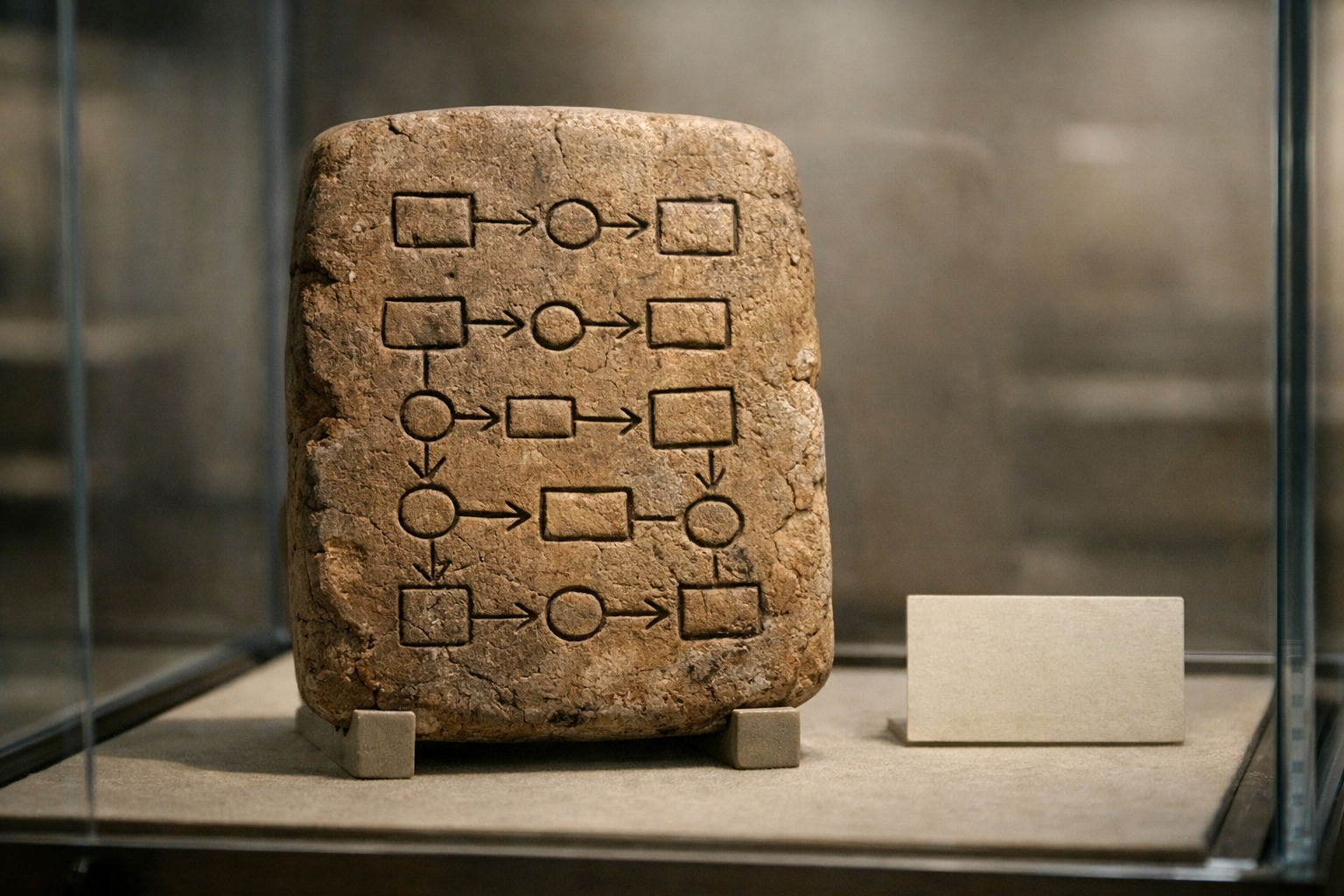
A Personal Retrospective
In the late 1990s, many developers (myself included) encountered JavaScript through the lens of Java. The name alone suggested classes, inheritance hierarchies, and object-oriented (OO) patterns that were already familiar—but JavaScript did not actually work that way. As a result, its true model remained obscure.
Looking back, it is striking how a single, well-chosen example could have clarified everything. A simple data structure—implemented cleanly and honestly in the prototype-based style—would have revealed what JavaScript was really about.
This paper presents such an example: a singly linked list, written in plain ES1-style JavaScript, without classes, without syntactic sugar, and without conceptual compromise.
The Core Idea: Objects Linked by Delegation
Prototype-based object orientation is not about types or inheritance trees. It is about:
- Objects holding state
- Objects delegating behavior through prototypes
- Explicit construction and composition
A linked list is ideal here, because it is itself a structure built from linked objects.
The Node: A Minimal Stateful Object
function LinkedListNode(value) {
    this.value = value;
    this.next = null;
}
This constructor does exactly one thing: create an object with state.
There is no behavior here. No methods. No inheritance. Just data.
Key points:
- Each invocation of
LinkedListNodewithnewproduces a fresh object instance:var node = new LinkedListNode(value);
The new operator is essential here: it allocates a new object, binds it to this, and links it to LinkedListNode.prototype. Without new, the constructor doesn’t create a fresh instance.
valueandnextare own properties- The node does not know about the list it belongs to
This strict separation is intentional.
The List Object: State Without Behavior (Yet)
function LinkedList() {
    this.head = null;
    this.tail = null;
    this.length = 0;
}
Again: pure state.
The list object tracks:
head: first nodetail: last nodelength: number of elements
No logic is embedded here. That comes next.
Adding Behavior via the Prototype
Behavior is shared by delegation, not copied per instance.
LinkedList.prototype.push = function (value) {
    var node = new LinkedListNode(value);
    if (!this.head) {
        this.head = node;
        this.tail = node;
    } else {
        this.tail.next = node;
        this.tail = node;
    }
    this.length++;
    return node;
};
What matters here is not the algorithm (which is straightforward), but the mechanics:
pushlives onLinkedList.prototype, not on individual list instances- Every
LinkedListinstance delegates method lookup to this prototype object - Any kind of value can be stored in the list (strings, numbers, arrays, or arbitrary objects)
new LinkedListNode(value)explicitly allocates a node object and initializes its local statethisis resolved dynamically at call time and always refers to the list instance on whichpushis invoked- If the list is empty, the new node becomes both
headandtail; otherwise, it is linked after the current tail and promoted as the new tail
There is no class. There is an object that other objects consult.
Prepending: Same Structure, Different Traversal
LinkedList.prototype.prepend = function (value) {
    var node = new LinkedListNode(value);
    if (!this.head) {
        this.head = node;
        this.tail = node;
    } else {
        node.next = this.head;
        this.head = node;
    }
    this.length++;
    return node;
};
The list remains consistent because:
- State lives on the instance
- Behavior lives on the prototype
- The algorithm manipulates links, not indexes
This reinforces an important lesson: structure emerges from references, not from containers.
Searching by Traversal
LinkedList.prototype.find = function (value) {
    var cur = this.head;
    while (cur) {
        if (cur.value === value) return cur;
        cur = cur.next;
    }
    return null;
};
Here we see object graphs in action:
- Each node references the next
- Traversal is explicit
- No abstraction hides the mechanics
This is prototype-based thinking at its clearest.
Removing a Node: Local Reasoning Only
LinkedList.prototype.remove = function (value) {
    var prev = null;
    var cur = this.head;
    while (cur) {
        if (cur.value === value) {
            if (prev) {
                prev.next = cur.next;
            } else {
                this.head = cur.next;
            }
            if (cur === this.tail) {
                this.tail = prev;
            }
            this.length--;
            return true;
        }
        prev = cur;
        cur = cur.next;
    }
    return false;
};
No global invariants. No superclass contracts.
Just:
- Local references
- Explicit mutation
- Clear ownership of state
This is object-oriented programming without ceremony.
Observation, Not Encapsulation
LinkedList.prototype.toArray = function () {
    var out = [];
    var cur = this.head;
    while (cur) {
        out.push(cur.value);
        cur = cur.next;
    }
    return out;
};
The list does not hide its internals behind layers of abstraction. Instead:
- Representation is stable
- Behavior is predictable
- Debugging is trivial
Nothing is implicit.
A Concrete Usage Example in ProtoScript
To conclude, here is a minimal but complete usage example written in ProtoScript. It shows how the data structure is consumed from user code, without any special syntax or runtime magic.
ProtoScript.include("LinkedList.js");

var list = new LinkedList();
list.push("b");
list.push("c");
list.prepend("a");

var found = list.find("b");
Io.print((found ? "found b" : "missing b") + Io.EOL);

list.remove("a");
Io.print("len=" + list.length + Io.EOL);

var values = list.toArray();
Io.print(values.join(",") + Io.EOL);
Several important observations can be made:
includeincludes a source file statically and executes it in the same global scopeLinkedListis used as a plain constructor function- Method calls (
push,prepend,find,remove) rely entirely on prototype delegation - The list exposes behavior, not iterators or hidden machinery
- State (
length, links between nodes) remains fully observable and predictable
This example demonstrates that prototype-based OO scales naturally from definition to usage, without any change in mental model.
Why This Example Matters
This small program demonstrates, in one place:
- Constructor functions as object factories
- Prototypes as shared behavior objects
- Delegation instead of inheritance
- Explicit object graphs
- No confusion between class and instance
Had this been shown early on, JavaScript would have been understood very differently.
Final Thought
Prototype-based OO is not a weaker form of class-based OO.
It is simpler, more explicit, and closer to how programs actually execute.
This linked list is not just a data structure.
It is a conceptual Rosetta Stone.
Alexandre Vialle